Case study
How a Fortune 500 FinTech’s accounting team uses Zamp to automate their monthly close
- 100% recall
- on every reclassification a human reviewer caught, zero misses
- $50M processed
- in reclassification, and escalated on the items that warranted a second look
- 85%+ AR
- automation rate on clean remittances
About the Org
This Fortune 500 fintech serves millions of merchants and consumers through a growing portfolio of financial products and services. With roughly 6,000 employees and $47.6 billion in market value, its operations span a high volume of financial transactions every month.
That scale also means a complex accounting operation. The team works under SOX audit requirements and manages dozens of recurring tasks during every monthly close, from reconciliations and reclassifications to invoice tagging and review.
Earlier, much of that work was handled manually. Today, Zamp runs a growing share of the close directly, matching payments, reclassifying expenses, and maintaining sub-ledgers, while logging every decision for review and audit.
The problem
A close cycle built around manual work
The company’s accounting team, made up of roughly 40 to 50 people, handled many recurring tasks manually every month. That included:
- Matching incoming payments to open invoices, credit memos, and vendor deductions.
- Reclassifying operating expenses that should be recorded as fixed assets or prepaids.
- Tagging invoices so they reached the correct account and sub-ledger.
- Reviewing transactions and documenting why each decision was made.
- Checking completed work before every close.
The tasks were repetitive, but they could not be ignored. Each one affected the accuracy of a public company’s financial records and had to withstand audit review.
That created a familiar constraint. The work was too small to take priority on engineering’s roadmap, but too frequent for the accounting team to keep handling manually.
The business needed a way for accounting to build and run its own automations without waiting for an engineering project.
The framework
Building from the team’s own playbook
The fintech’s accounting team had already explored AI and built automation for parts of the close process. The team had access to Claude and Goose, an open-source AI agent that runs locally and can support tasks such as research, coding, writing, and data analysis.
But the homegrown workflows were difficult to rely on during close.
- The same input did not always produce the same output.
- They lacked controls designed for SOX review, and there was no interface for an accountant to examine the work after it was complete.
- Reviewers still had to repeat the task by hand to confirm that the result was correct.
We filled that gap by combining direct system access with the controls the accounting team needed. It pulled general ledger and accounts payable data from Oracle Fusion Cloud and used BlackLine exports for the fixed asset and prepaid sub-ledger workflows. The company did not need to change its existing process, and its data pipeline stayed the same.
The harder part was capturing the knowledge that lived with the accountants themselves, reasoning built up over years of running the close. Our team worked directly with the accountants in live sessions, walking through their existing playbooks step by step, until that reasoning was captured, not just the steps.
That reasoning is now built into how every workflow runs. Zamp logs the basis for each classification decision, traces every transaction from where it starts to where it lands, and runs an automatic five-point SOX review on OPEX workflows.
An accountant can review and sign off on the work the way they’d review a colleague’s, without redoing it from scratch.
Getting there took real iteration. The OPEX automation went through three production versions in its first two months live: the first surfaced 20 gaps against what a human reviewer would have caught, the second closed all but two, and the third closed those, validated against a full month of parallel human review before the team trusted it on real data.
Our solution
From one workflow to four
We started with the process eating their most manual time: AR cash application. Every incoming payment, mostly from Amazon, arrives as a remittance email that has to be read, matched line by line against open invoices, credit memos, and vendor deductions, checked against a running list of deductions to catch duplicates, and only then posted as a cash entry.
Our AI employee takes over that entire chain. It reads the remittance, does the matching, verifies the math reconciles to the penny, and posts the entry, pausing only when something genuinely doesn’t add up, which is the one case that still needs a person. That went live in March 2026.
Then we expanded into three more operations around the close:
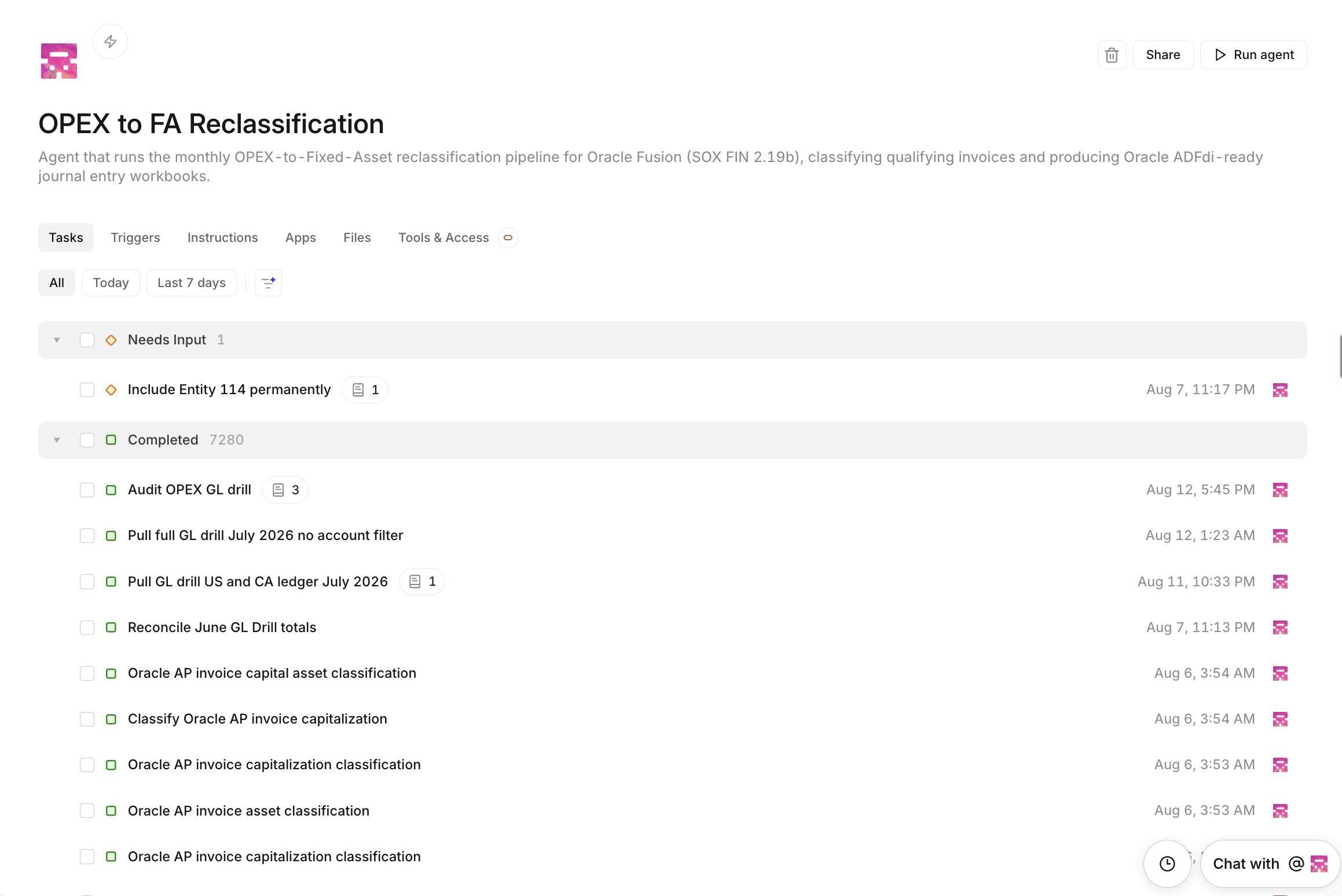
OPEX to FA/PPD reclassification
Every operating expense that should actually sit on the balance sheet (a laptop purchase miscoded as a supply expense, a year-long software contract booked as a single month’s cost) has to be caught, reclassified, and turned into a properly balanced journal entry, with the amortization schedule calculated correctly and every clearing account assigned by rule.
Zamp runs this end to end: pulling the general ledger and invoice data directly from Oracle Fusion, reading each invoice to make the classification call, doing the accounting math deterministically so nothing drifts, and building journal entries that pass the company’s SOX review before they’re posted.
FA/PPD sub-ledgering
Once an expense is reclassified, it still has to land correctly in the fixed-asset and prepaid sub-ledgers. Zamp closes the gap between GL reclassification and subledger accounting by preparing, reconciling, and staging the Fixed Asset and Prepaid/ACCAP additions needed for each monthly close.
Chargeback and remittance processing
Beyond Amazon, the payments business deals with retailer-specific chargebacks and remittances, Best Buy chargebacks, Staples credit and debit memos, each with its own portal, format, and quirks.
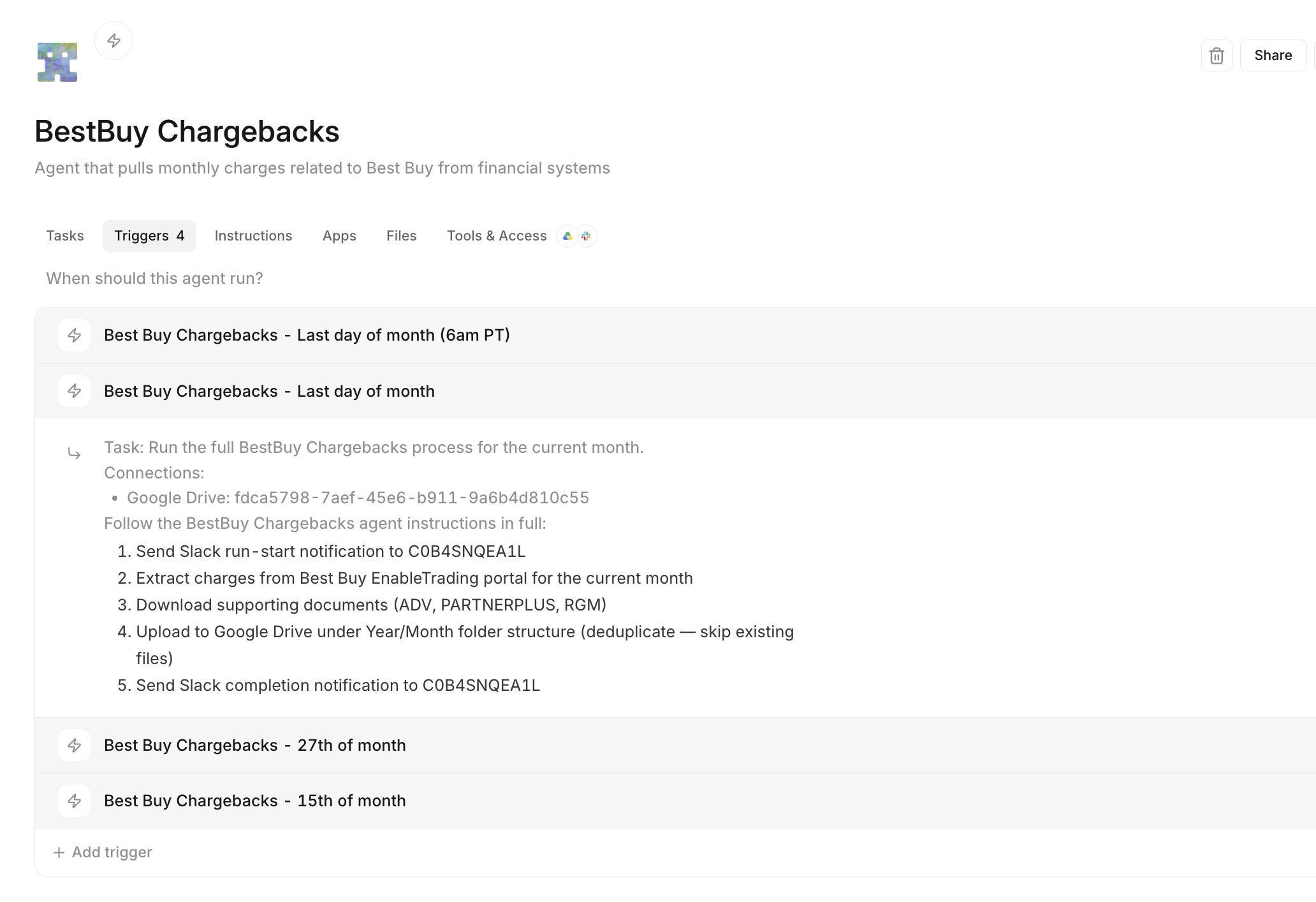
One of their teammates independently built four scheduled triggers using Zamp’s self-serve, which runs an end-to-end chargeback pipeline automatically on the last day of every month.
Zamp logs into the relevant portal on a set schedule, pulls the documentation, and processes the remittance data automatically, so nobody on the team has to remember to go collect it.
By mid-2026, all four were running against live company data, with the AR and sub-ledgering workflows fully in production and OPEX reclassification maturing through real monthly cycles, together handling thousands of tasks a month, the overwhelming majority of it without anyone needing to step in.
Finally, the result
Moment the team saw a difference
The breakthrough came during a live session with the accounts receivable team.
With a single prompt, Zamp logged into a retailer portal, opened individual chargeback records, and downloaded each document as a PDF. Every action appeared on screen as it happened.
The task had been attempted before. Two years earlier, the team had worked with an RPA vendor to automate the same process. After five months of engineering effort, it still did not work.
Our AI employee completed the process in one pass.
What’s changed
More time for judgment and control
With manual AR remittance work and monthly reclassification work off their plate, the accounting team can spend more time on the work that requires their expertise. That includes:
- Finding discrepancies before they become larger problems.
- Making judgment calls on unusual or complex transactions.
- Reviewing edge cases.
- Improving how the monthly close should run.
- Planning the next set of accounting workflows to automate.
In one monthly cycle, Zamp processed $41.75 million in reclassifications across 440 journal entry lines. Fewer than 10% of items required human review, and every SOX check passed.
Our AI employee now serves the team in three ways. It works as an AR cash application analyst, a staff accountant for OPEX-to-FA/PPD reclassifications, and an invoice-tagging clerk for accounts payable. It also maintains its own audit trail, recording each decision as the work happens.
At the same time, Zamp gives accounting leads a self-serve way to create new automations with guidance, without waiting for engineering capacity.
The team is now scoping what comes next, starting with cleaner reconciliation across the business and a faster, more confident close.
The automation journey with Zamp
- March 2026: AR cash application went live.
- Following months: OPEX reclassification and FA/PPD sub-ledger workflows go into production.
- August 2026: Four automations process thousands of monthly tasks, with most work running unattended.
- Next: Cleaner reconciliation and continued improvement of the close process.
The first time we saw Zamp log into a vendor portal, click into each chargeback on its own, and pull down forty documents, it was honestly a little scary, and genuinely impressive. We’d tried to build something like that with an external RPA vendor a couple of years back and never got it working, even after five months of engineering effort. With Zamp, it just ran, start to finish, and we had everything downloaded within minutes.

Head of Revenue and Product Accounting, Fortune 500 FinTech
- Financial Technology
- Accounting & Close
- United States