


A month ago, I was part of Zamp’s core team, where we deployed an eKYC agent for the property management division of a leading UAE business group.
Previously, their team of 10-12 leasing and property managers handled every KYC check manually.
Documents came in through multiple channels, and they had to review each file, extract the required information, and manually update them on Salesforce.
They faced two major problems:
- Leasing managers spent hours on administrative paperwork instead of focusing on closing deals.
- Without a clear SOP or standard checks, reviews were inconsistent and prone to error.
In this piece, I will walk you through the exact steps our agent follows to automate tenant screening end-to-end.
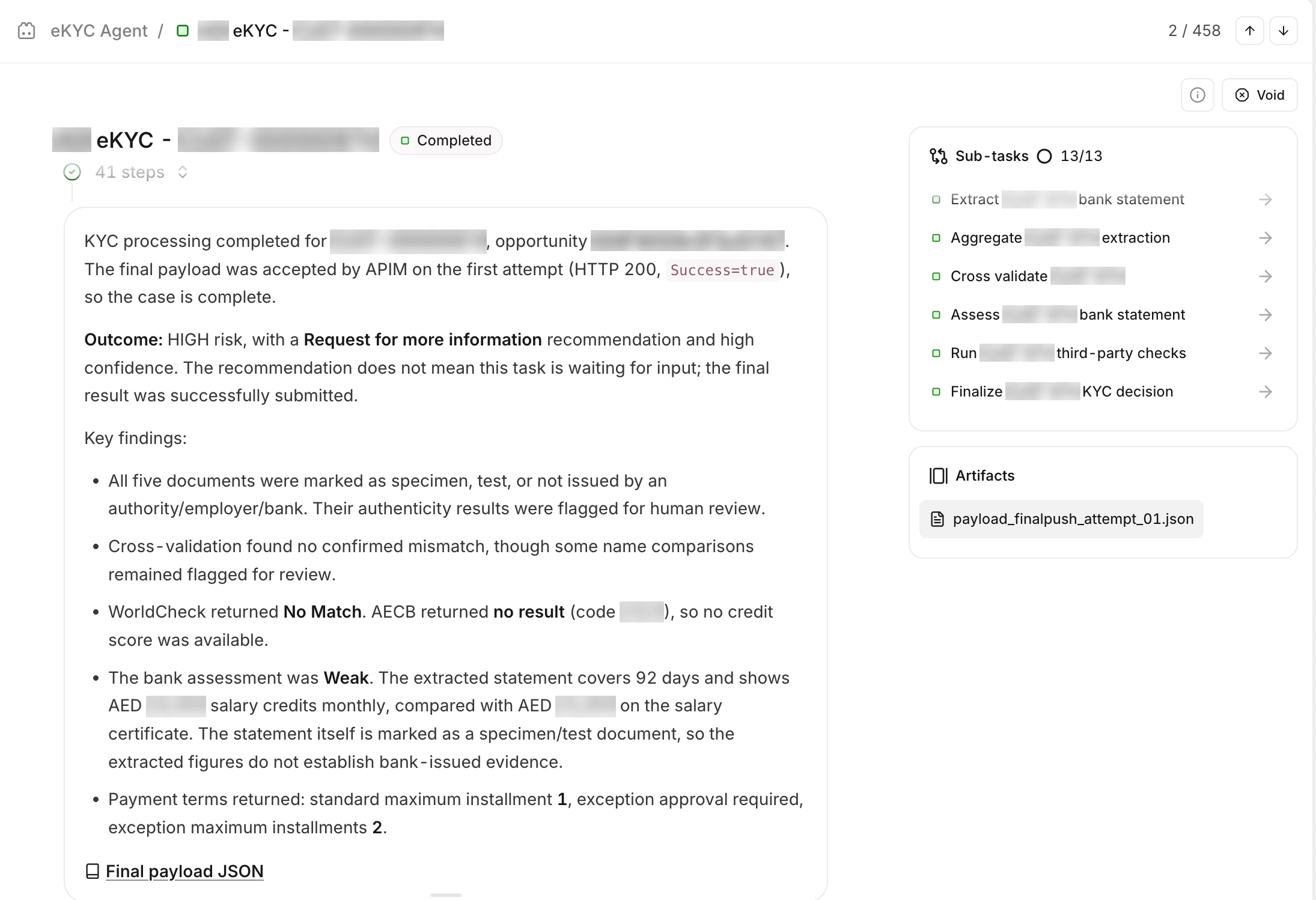
A snapshot of our eKYC agent
If you’re interested in how AI agents can be useful in the space of property leasing, this is for you.
The 8-step process
Our agent follows eight steps to verify documents, assess applicants, and prepare the results for the leasing team.
Step 1: Intake
Once a prospective tenant selects a property, books a viewing, and decides to rent it, they submit a KYC application through the company’s property portal.
Our agent receives the applicant’s basic details, including their first name, last name, and mobile number, along with the required documents.
- Salaried employees upload five documents: an Emirates ID, passport, bank statement, salary slip, and residential visa.
- Self-employed applicants upload their bank statement as proof of income and business trade license.
All this granular information gets recorded on Zamp against the customer reference number.
Step 2: Usability
Next, our agent checks each uploaded file to make sure it is the correct document and contains all the required information.
Things like: Is the document blank? Is it the wrong document, a random PDF, or just a screenshot? Are all the required fields visible?
If all the uploaded files are unreadable or incorrect, the agent stops the process and flags the application. But if at least the required documents are legible, the agent moves to step 3.
Step 3: Authenticity check
In this step, the agent inspects each document to verify whether it is genuine:
- Verifies document codes and reviews specimen details to detect potential signs of tampering or forgery.
- Checks every file for irregularities, missing details, or altered sections.
One important distinction is that our agent never outright declares a document "fake."
Instead, if anything appears missing or tampered with, it flags the application for human review so a leasing manager can make the final call.
Step 4: Extraction
Once the documents pass the usability checks, our agent extracts the relevant information from each file.
This includes details such as the applicant’s full name, passport number, and date of birth.
The agent also checks the dates on the submitted identification documents to flag any that have expired.
Step 5: Cross-validation
Now that the agent has extracted data from every document, it checks whether these details match across the board.
Beyond the uploaded files, the applicant also enters three key details into the portal form: their first name, last name, and mobile number.
The agent compares these inputs against the information extracted from the Emirates ID, passport, and salary slip.
Here is how it works:
- Cross-document matching: Unlike Step 3, which inspects single documents individually for authenticity or tampering, Step 5 checks consistency across files, confirming that the name on the Emirates ID matches the passport, which matches the salary slip.
- LLM-based matching: Using LLM reasoning, the agent automatically differentiates between minor formatting variances (a benign variant, such as an included middle name) and actual data mismatches.
- Handling discrepancies: When the agent detects a minor variance, it flags the record for human review and proceeds without interrupting execution. If a hard mismatch occurs, the application is returned to the original applicant for correction.
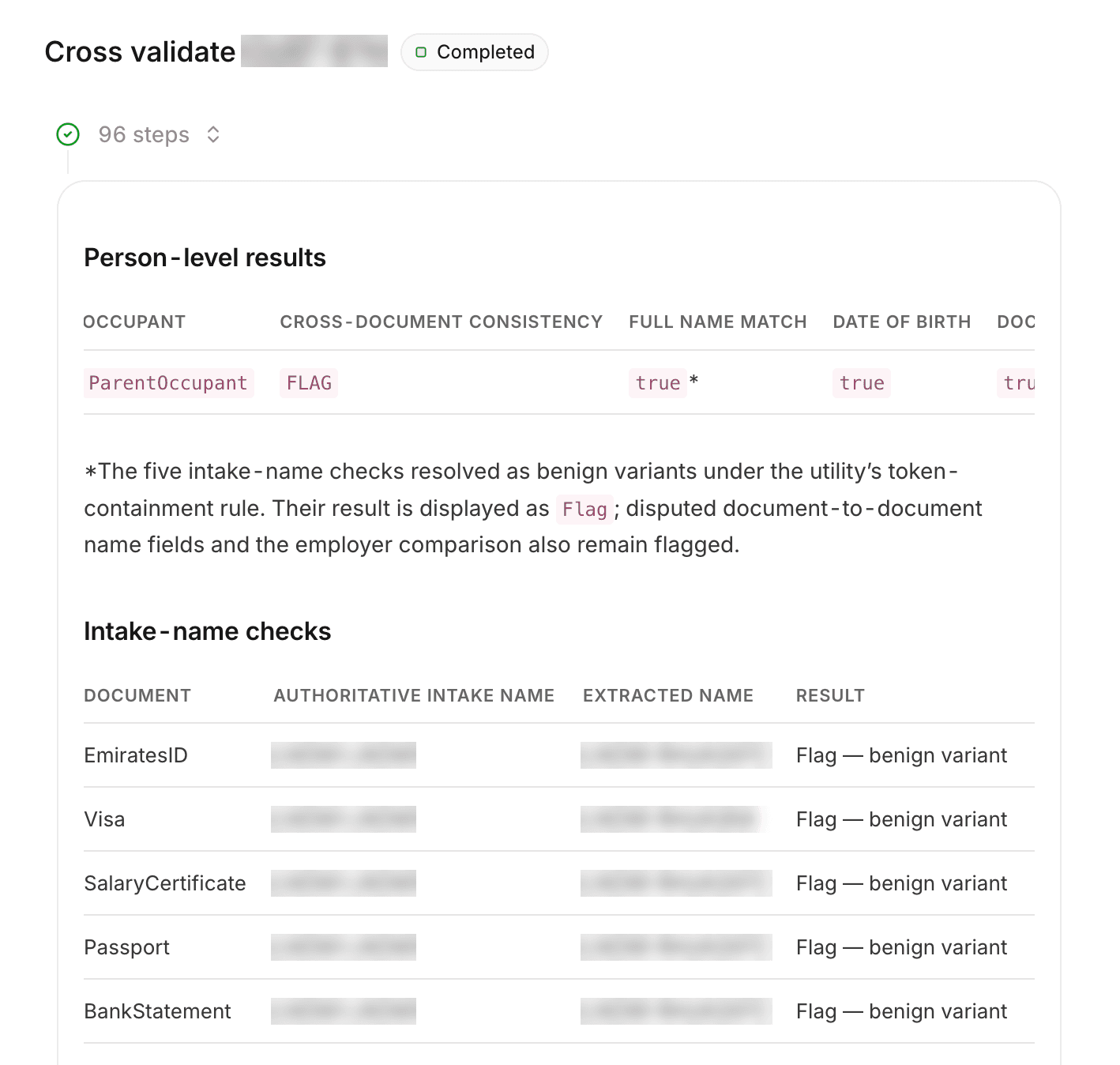
Agent checks that the applicant’s name matches across every document and the application form
Step 6: Bank statement assessment
The client's leasing team uses a fixed matrix to evaluate bank statements based on three primary criteria:
- Rent-to-salary ratio must be below 30%.
- There must be no bounced cheques.
- There must be zero uncleared bounced cheques.
When an applicant meets all three conditions, their profile is marked as a strong financial fit.
In this step, our agent reviews the applicant's financial capability to verify that their income comfortably covers the rent.
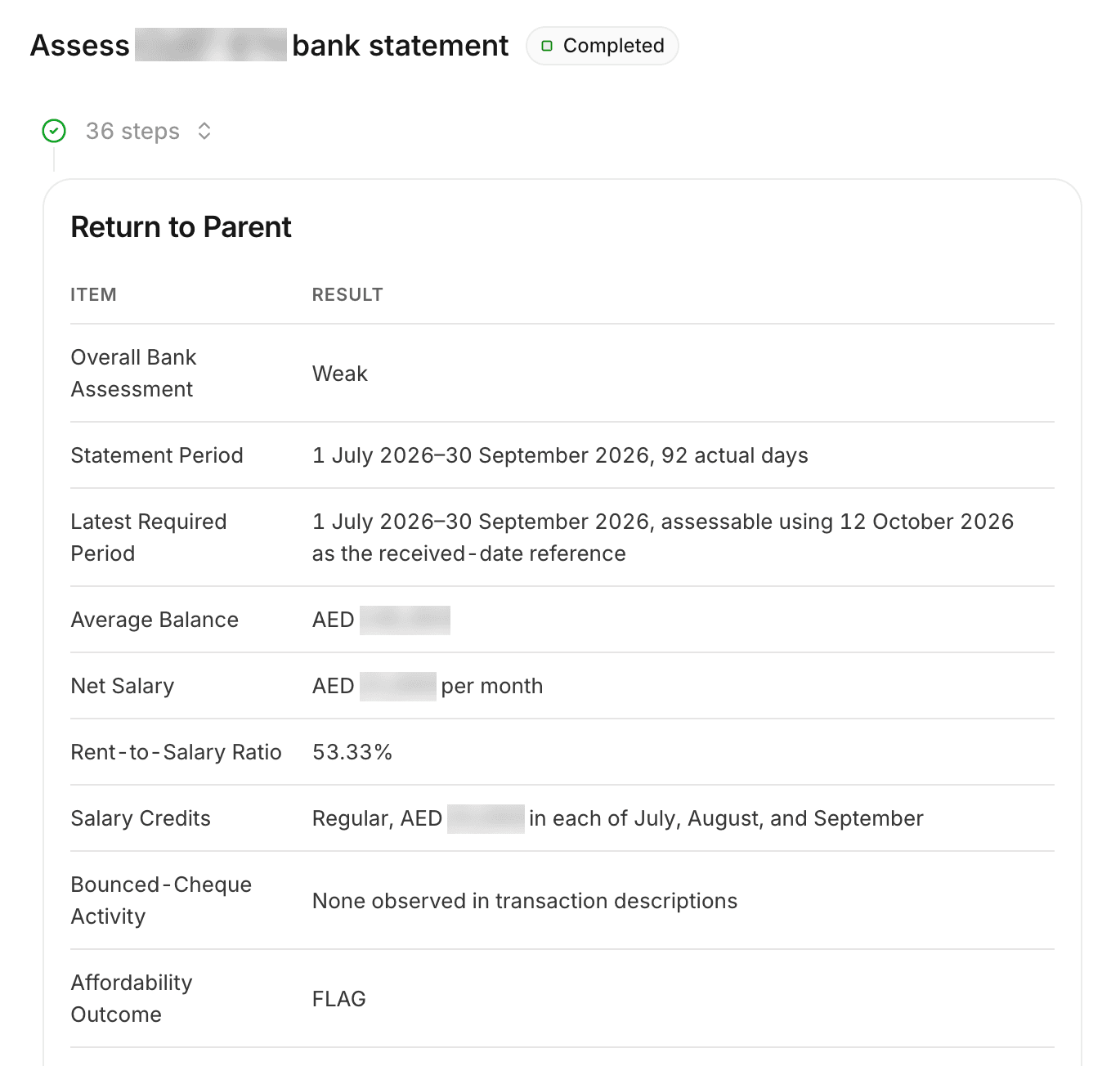
Agent reads the bank statement, works out net salary, and checks whether the rent is affordable. Here, a 53% rent-to-salary ratio means a weak statement.
This is how it works:
- Statement validation: Before evaluating transactions, the agent checks that the uploaded bank statement covers a continuous 90-day period from the last three months.
- Identifying income: The agent reads line-by-line through the transaction descriptions to find real salary deposits. It skips random or one-off credits and focuses only on steady, recurring income.
- Calculating net salary: The agent subtracts fixed monthly commitments (like car loans or credit card EMIs) from total earnings, while ignoring everyday expenses like groceries or dining out, to find the applicant's true net monthly salary.
- Checking affordability: It then compares the net salary to the property’s rent listed on the portal. For instance, if the annual rent is 70,000 AED, the agent calculates the exact rent-to-salary ratio. Anything over 30% gets marked as a weak assessment.
Step 7: Third-party checks
Next, our agent runs two quick checks through the property team’s existing verification partners:
- WorldCheck (Risk & sanctions screening): The agent screens the applicant's name for financial crime, legal issues, or political exposure. No match means the applicant is clear. A partial match marks the profile as medium risk and sends it to the team for human review. A 100% match flags high risk and rejects the application automatically.
- AECB (Credit bureau scoring): The agent pulls the applicant’s official credit score from the Al Etihad Credit Bureau (scored up to 900). Scores between 650 and 900 are mapped straight to the low-risk category.
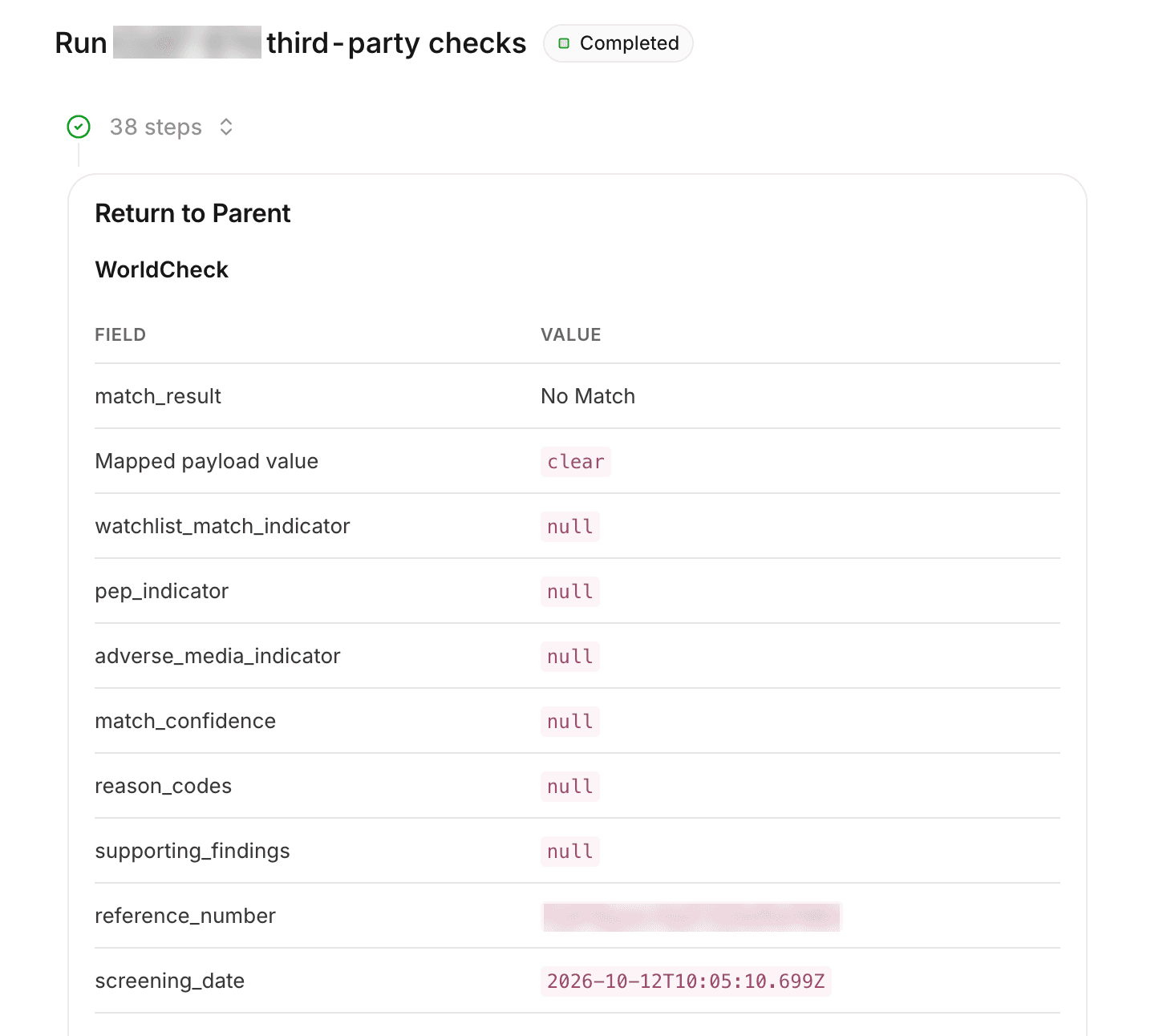
Third-party screening, done automatically and mapped straight into the risk decision
Step 8: Risk decision
In this final step, our agent combines every insight gathered from the previous seven steps to deliver a complete risk decision, state its reasoning, and set clear rental terms.
- It assesses overall risk (low, medium, or high) and logs a clear summary explaining its decision.
- Based on the bank statement evaluation and the AECB credit score, the agent automatically sets the allowed payment terms. A strong profile might qualify for 12 monthly cheques, whereas a weaker profile may be restricted to a single full-year payment.
- Once the analysis is complete, the agent sends the results and step-by-step reasoning back through the API to populate the leasing dashboard in Salesforce.
From there, the leasing manager reviews the complete dashboard to make the final call: approve, reject, or request further details.
If an updated file is needed (like a renewed Emirates ID), the request flows back to the main portal.
When the applicant re-uploads the document, Zamp picks up the process right where it left off, running the check only for that newly provided file.
That is the end-to-end process.
Wrapping up
Since it has gone live, our eKYC agent has cut application processing time by almost 80%, turning what used to take days into a same-day review.
It now comfortably handles 300 to 500 applications monthly, processing every document and running every check automatically.
There’s a considerable amount of time saved, which allows their team to focus on other strategic work, like building customer relationships.
And this use case extends beyond real estate.
KYC is a common process across banking, finance, insurance, and other industries where businesses need to verify identities, review documents, and assess risk.
At Zamp, our motto is to automate the grunt work and complex processes of large-scale businesses so humans can focus on higher-value work.
The best part about our AI employees is that you can onboard them just like how you’d hire a new team member.
Learn more at: zamp.ai. Originally published on Levin's LinkedIn and X.


