

Chargeback automation is software that detects disputes the moment your payment processor flags them, pulls the right evidence from your order, payment, and customer systems, builds a card-network-compliant representment package, and submits it before the deadline. With AI now driving evidence selection and the rebuttal narrative, that work no longer needs a person babysitting each case. Done well, chargeback automation sits at the heart of chargeback management, weaving chargeback prevention upstream and automated representment downstream into one auditable pipeline that recovers revenue and lowers your dispute ratio.
Chargebacks are a deep, still-central use case for Zamp in banking, and one instance of a wider pattern. The same dispute-resolution architecture also runs freight-order exceptions and multi-entity billing disputes outside finance entirely. Background: why Zamp isn't just a finance AI company.
A quick note before we go further. This guide is from Zamp, the AI digital-employee platform for the enterprise back office at zamp.ai. It is not the "Zamp HR" payroll product, and it is not the zamp.com US sales-tax platform. Different companies, similar name, frequent confusion.
What chargeback automation actually is
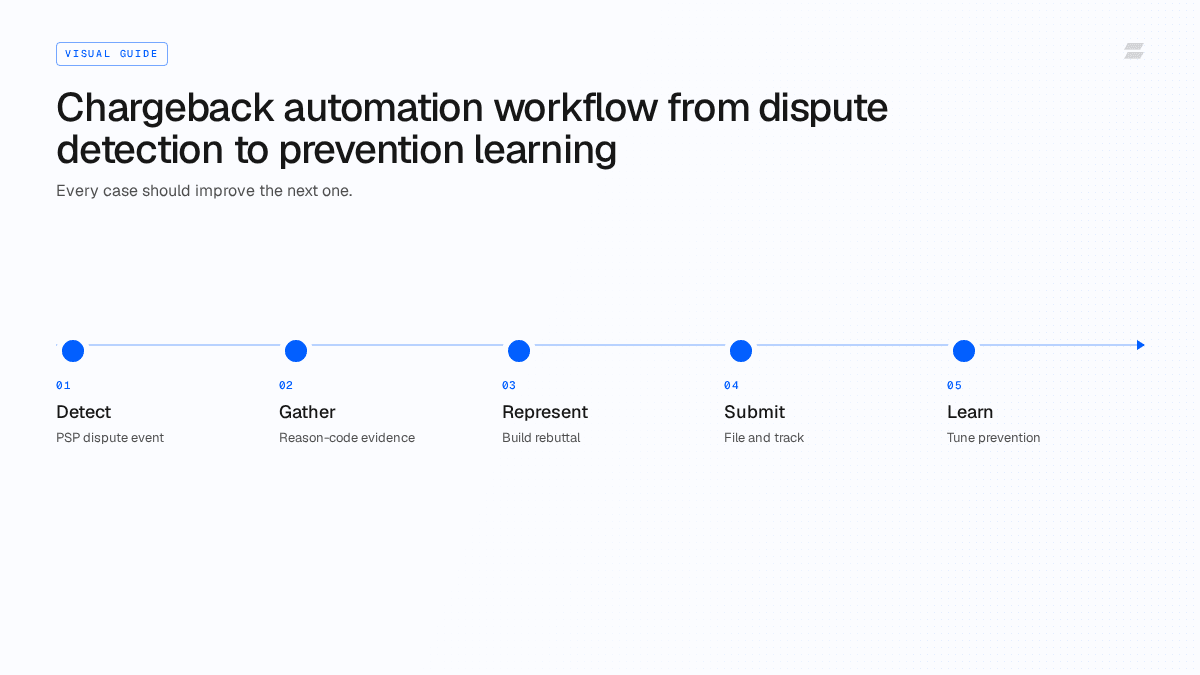
Strip away the marketing copy and chargeback automation does four jobs:
- Detect. Listens for dispute events from your payment service provider (PSP), acquirer, or alerts network. Often via webhooks, sometimes via polling. The clock starts the second a case opens, and the network deadline is non-negotiable.
- Gather. Pulls the evidence each reason code requires. A "fraudulent" dispute on a card-not-present transaction needs different artifacts than a "goods not received" claim. Good automation maps reason code to artifact list and goes hunting across your OMS, CRM, fraud tools, shipping carrier APIs, and customer-communication logs.
- Represent. Builds a network-compliant evidence package (Visa, Mastercard, Amex, Discover all have their own rules) and writes a rebuttal narrative tying the evidence to the reason code. AI now does this drafting more often than not.
- Learn. Tracks win and loss outcomes by reason code, issuer, BIN, product, and channel, then feeds those signals back into the prevention layer and the representment strategy.
That is chargeback automation, chargeback management software, and dispute management software in the same sentence. They are different vendor labels for largely overlapping product shapes, with subtle emphasis differences worth keeping straight.
PROCESS MAP
The closed-loop chargeback system
The value compounds when case outcomes improve prevention.
DetectDispute event→GatherReason-code evidence→RepresentBuild rebuttal→SubmitFile and track→LearnTune prevention
Chargeback management vs prevention vs representment
These three terms get used interchangeably in vendor copy. They are not the same thing.
Term | What it focuses on | When in the lifecycle | Typical tools and actions |
|---|---|---|---|
Chargeback prevention | Stop disputes before they become chargebacks | Before, or at the very start of a dispute | 3DS, AVS and CVV checks, velocity rules, fraud scoring, clear billing descriptors, proactive refunds, and pre-dispute alert networks like Verifi and Ethoca |
Chargeback representment | Fight invalid chargebacks and recover revenue | After a chargeback is filed | Collect evidence, build a network-compliant rebuttal, submit to the acquirer on a strict timeline, then track through pre-arbitration and arbitration |
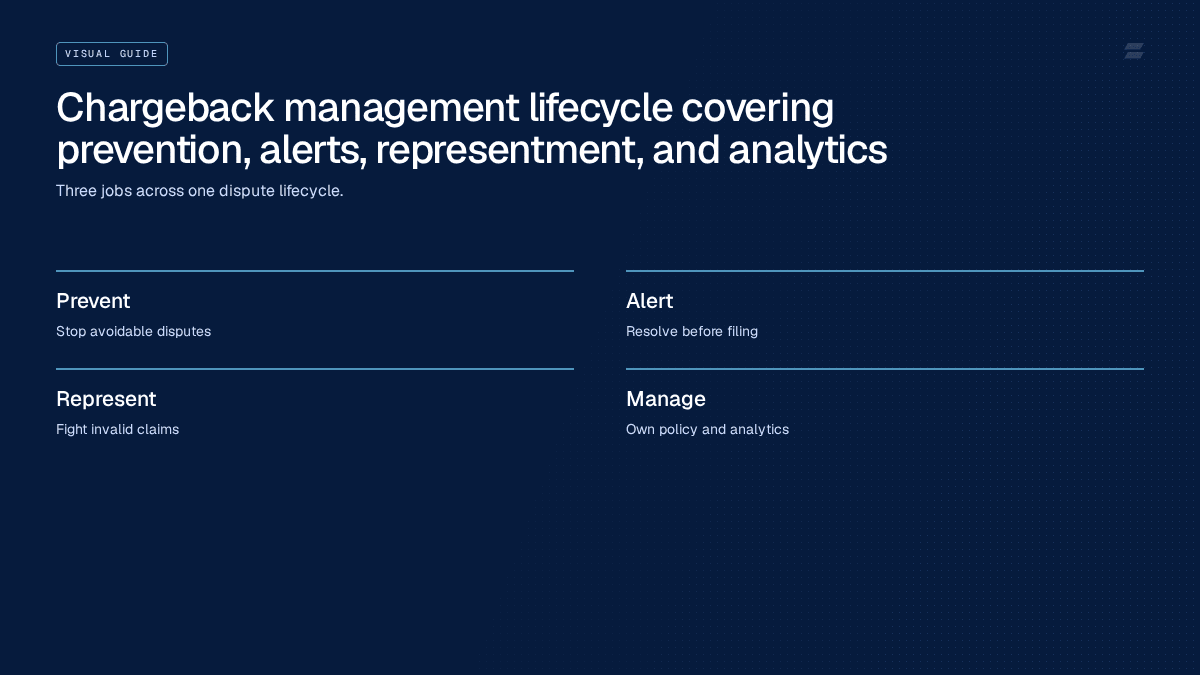
Chargeback management | Own the full lifecycle and policy | Spans prevention + representment + analytics | Software and process to monitor disputes, automate responses, track KPIs (dispute ratio, win rate by reason code), route cases, manage provider relationships, and feed insights back into risk and CX policy |
Said plainly: prevention is "don't let it happen," representment is "if it happened and it is invalid, fight it," and management is "own the whole loop end to end and improve it."
Modern chargeback management software tries to do all three from one console. Whether it actually does all three well, or just one of them with the others bolted on, is the question every buyer should ask.
How chargeback management software works (step by step)
Under the hood, most chargeback automation platforms run the same five-step loop. The differences live in how deep each step goes and how much of it the AI runs without a human in the loop.
1. Real-time dispute ingestion
When an issuing bank files a chargeback, your PSP raises an event. Stripe sends a charge.dispute.created webhook. Adyen sends CHARGEBACK. Braintree, Worldpay, Cybersource, every PSP has its own variant. The software registers that event, parses the reason code, captures the network deadline, and writes a case to its dispute queue. The first job is to never miss the clock.
Decent automation here means every PSP and acquirer you use gets ingested into one queue. Half-automated setups, where one PSP feeds the tool and the others are spreadsheets, are where deadlines get missed.
2. Reason-code-aware evidence gathering
Each network publishes its own reason-code library. Visa has roughly 25 active codes, Mastercard a similar number, Amex its own set, and each code demands a different evidence kit. "10.4 fraud, card-absent environment" wants AVS, CVV, 3DS authentication results, IP, device fingerprint, prior order history, and delivery confirmation. "13.3 not as described or defective" wants the product description, photos, return policy, communication trail, and refund timeline.
The software queries your OMS, CRM, shipping carrier, fraud tool, and email/ticket system for the artifacts that reason code requires. The good systems maintain that mapping themselves and update it when the networks change their rules. The poor ones make you maintain a static template.
3. Dynamic representment package generation
This is where AI started earning its keep. The system formats the evidence into the network's required submission schema (Visa Claims Resolution, Mastercard Excessive Chargeback Program, and so on), then drafts a rebuttal narrative tying the evidence pieces to the reason code being disputed. Old-school chargeback software used static templates and rules. AI-driven systems write a fresh narrative for each case, often outperforming templates on win rate because they reference specifics ("delivery confirmed to billing address on date X by carrier Y, recipient signature on file") rather than generic boilerplate.
4. Programmatic submission and tracking
The package goes to the acquirer through API where supported, or via portal upload where not. Some platforms still rely on human submission for certain acquirers, which is a giveaway that "automation" is partial. The case then enters tracking: status, win or loss, pre-arbitration, arbitration, final decision.
5. Analytics and the prevention feedback loop
This is the step most teams treat as optional, and the one that compounds. Outcomes feed back into:
- Win-rate dashboards by reason code, issuer, BIN, product, channel, and acquirer
- Prevention rules (if 60 percent of disputes on a SKU are "not as described," the product page or description needs fixing, not the rebuttal)
- Risk scoring in your fraud tool (issuers with poor representment outcomes get treated more cautiously upfront)
- Customer-experience policy (high refund-vs-dispute ratios on a journey suggest a friction point worth fixing)
Without this loop you are running an expensive collection of webhooks. With it, you are running an actual chargeback management program.
Chargeback prevention: stopping disputes before they cost you
A representment win recovers a fee and a sale. A prevented dispute keeps the customer relationship, the dispute ratio, and the issuer's view of you intact. The math favors prevention almost every time, and serious chargeback management software takes it seriously.
The prevention layer has three main moves:
Authentication friction at the right moments. 3DS, AVS, CVV, and step-up authentication on risky transactions catch the obvious fraud attempts. The trick is to apply friction where it pays back and skip it where it costs more in conversion than it saves in disputes. Adaptive 3DS, where the rules trigger on risk score rather than uniformly, is the current standard.
Pre-dispute resolution. Networks now expose alert networks (Visa's Order Insight and Rapid Dispute Resolution, Mastercard's Consumer Clarity, Verifi and Ethoca on top) that let merchants respond to a customer inquiry before it becomes a chargeback. Chargeback alerts surface these in real time. The right move is usually a fast refund or clarification, which costs less than the dispute and the fee.
Pattern-based blocking. Velocity rules, geo-risk rules, device fingerprinting, and behavioral scoring catch what authentication misses. Chargeback prevention software in 2026 is mostly an AI fraud model with explainable rules layered on top, not a static rule engine.
Two practical points worth flagging:
- Prevention without representment is leaving money on the table. Some legitimately filed disputes are still invalid, and not fighting them tells issuers your dispute ratio is higher than it actually is.
- Heavy prevention without measurement is a friction trap. Track approval rate, false-positive rate, and customer drop-off alongside dispute ratio. Optimize the joint metric, not any one in isolation.
Where AI changes the game
For ten years, chargeback automation meant rules engines and static templates. The shift now underway is from "automate the steps a human used to do" to "let an AI agent run the case end to end, with a human approving the calls that matter."
What that actually unlocks:
AI-driven evidence selection and narrative. Instead of attaching every artifact the template lists, the AI picks the strongest evidence subset for this specific reason code, issuer, and case profile, and writes the rebuttal narrative around them. In practice this lifts win rates several points over templated submissions because issuers reading hundreds of rebuttals reward specificity.
Win-rate prediction and case triage. Real-time scoring of each case ("this one is 85 percent winnable, this one is 20 percent") lets you triage. Auto-fight the high-confidence cases, route the marginal ones to a senior analyst, and either accept or fast-refund the losers rather than burn the time. RapidCanvas published a case study showing meaningful gains from exactly this pattern in a chargeback provider's operations.
From scripts to AI agents. Older automation is RPA on top of brittle scripts. Read the glossary entry on robotic process automation for the contrast. A modern AI agent can fetch dispute data across PSPs, fraud tools, and issuer portals, investigate the case against customer and order history, classify it, write the rebuttal, file in the portal, and report back, all while keeping a human in the loop on the policy calls. That is what we mean at Zamp when we talk about a digital employee handling chargebacks rather than a tool a person operates. We covered the dedicated agent for this in AI agents that fight chargebacks end-to-end.
A real point worth saying out loud: AI does not "win" true fraud. If a stolen card was used in a card-not-present transaction and your fraud tools missed it, the liability is yours and no clever rebuttal changes that. AI wins friendly fraud and misunderstanding cases, which are the bulk of representment volume.
INTERACTIVE CALCULATOR
Estimate recoverable chargeback revenue
Use your monthly case volume, average disputed value, and expected win-rate lift.
Cases per monthAverage value ($)Win-rate lift (%)
What good chargeback automation looks like (buyer checklist)
Twelve criteria that separate real chargeback management tools from rebranded ticket queues. Use this as your scorecard.
- PSP and acquirer coverage. Every processor you use, ingested into one dispute queue. Not "Stripe today, the rest by Q3."
- Live reason-code library. Updated when networks change rules (which they do, quarterly). You should not have to maintain templates.
- Deadline tracking with safety margin. Cases auto-escalate before deadline, not at deadline.
- Evidence enrichment across your stack. OMS, CRM, fraud tools, shipping carriers, communication logs, fetched and attached automatically. Bonus for AVS, CVV, and 3DS pull-through.
- Network-compliant submission. Visa Claims Resolution, Mastercard's chargeback rules, Amex, Discover. The platform owns the rule changes, not you.
- Win-rate analytics by every cut. Reason code, issuer, BIN, product, channel, acquirer. If you cannot slice it, you cannot tune it.
- HITL controls. Configurable approval thresholds, queueing for exceptions, audit trail on every decision. Read the glossary entry on human-in-the-loop if HITL is new to your team.
- Audit trail. Every action and every decision, by user or agent, with timestamps. See audit trail for what good looks like. Auditors will ask, and so will your card brand.
- Pre-dispute alerts integration. Verifi, Ethoca, RDR, Order Insight, Consumer Clarity. Chargeback alerts surfaced and acted on in one place.
- Integration depth. API and webhook coverage that lets the tool be embedded in your ops, not a separate console your team has to switch into.
- Transparent ROI math. Cost per case, recovered revenue per case, win rate by reason code, all visible. Vendors who only show topline "saved" numbers are hiding the breakdown.
- Real exception handling. What happens when the evidence cannot be found, the reason code does not match the dispute description, or the issuer requests a non-standard format. Tools that punt these back to a human queue are doing half the job.
If a platform you are evaluating fails three or more of these, it is chargeback software in the older sense, not chargeback management software in the modern one.
Build vs buy vs digital employee
Three real choices, not two.
Build. Worth it if disputes are central to your product (you are a PSP, an acquirer, or a marketplace with unique reason-code patterns). Otherwise you are paying engineers to maintain network rule libraries on quarterly cadence, which is not what you hired them for.
Buy a chargeback automation tool. The right call for most ecommerce and SaaS merchants whose dispute volume justifies a dedicated product. Pick on PSP coverage, audit depth, and HITL controls, not on the win-rate marketing.
Hire a digital employee. The right call when (a) your back office needs more than chargebacks (AR, AP, refunds, support overlap), (b) decisions span systems that no single SaaS tool integrates, or (c) you want the audit trail, the policy controls, and the cross-system orchestration that a real employee would have, without the headcount. The Zamp piece chargebacks are eating your margins, here's how digital employees fight back walks through the math of when this option pulls ahead.
If you are choosing between buying chargeback software and adopting a digital employee, the real question is whether you want a tool your team operates or a team member that handles the work and reports back. Both are valid. They are not the same product.
Implementation: a realistic 30/60/90
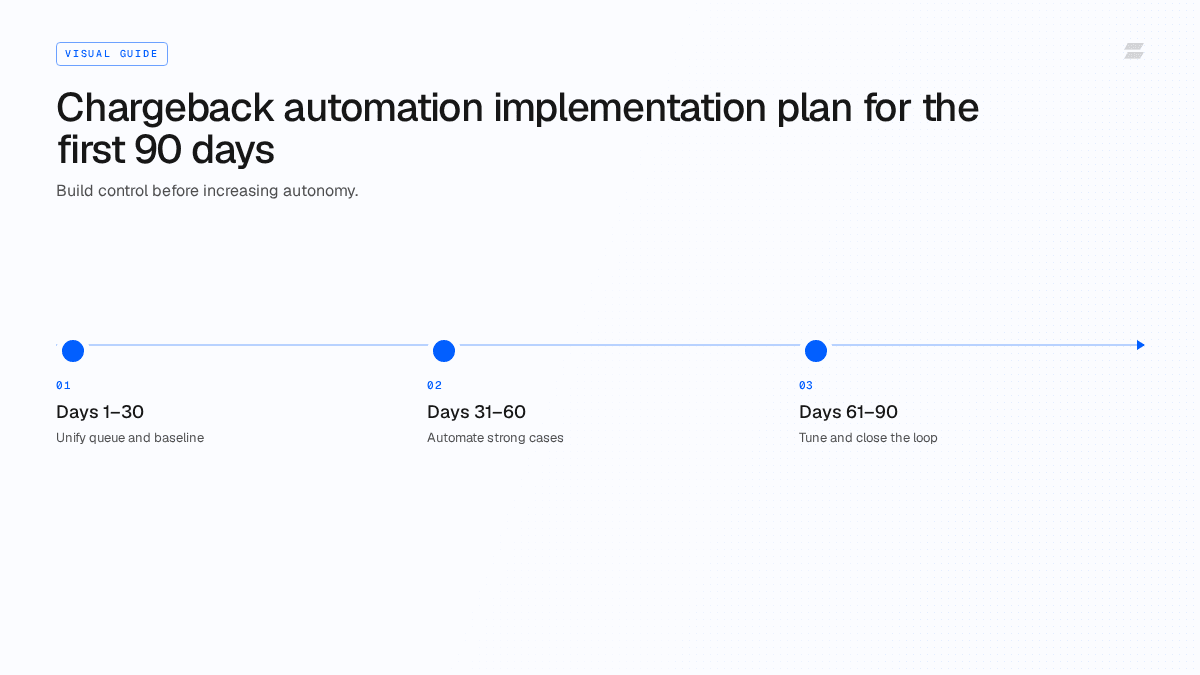
A realistic 30/60/90 for standing up a chargeback automation program. What "good" looks like by phase, not by marketing slide.
Phase 1: Foundation (Days 1 to 30)
Get every dispute into one queue and baseline the numbers you are going to optimize against.
- Connect every PSP and acquirer to the dispute queue. No spreadsheet sidecars.
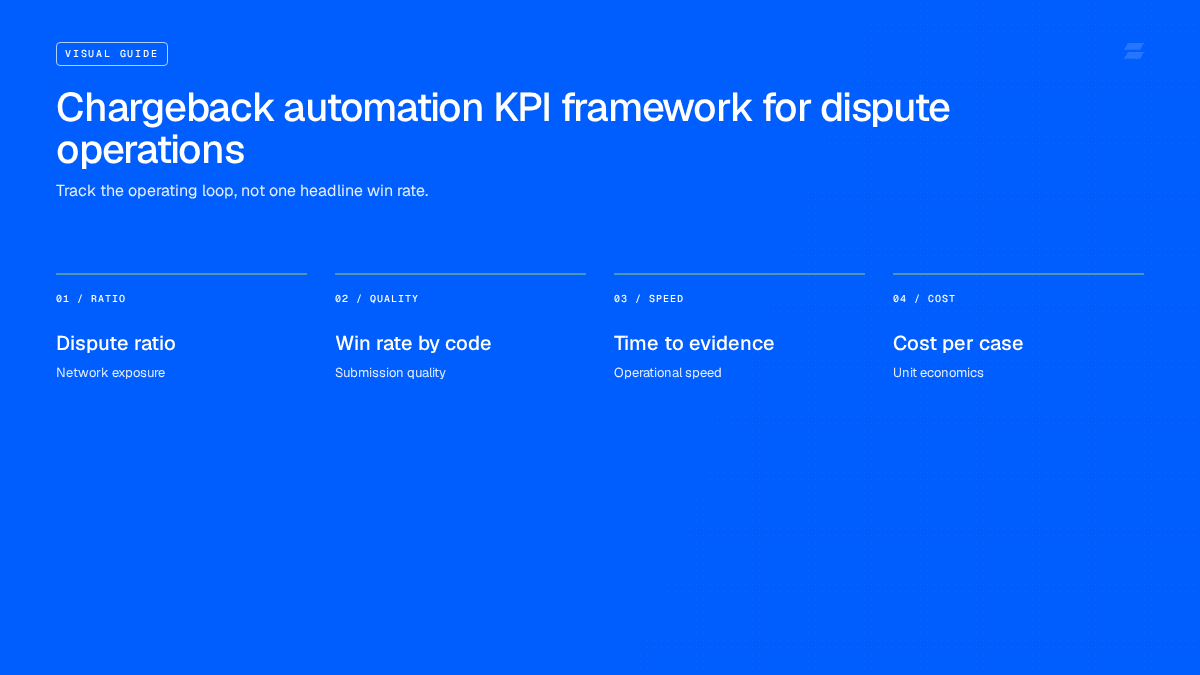
- Baseline the metrics: monthly dispute count, dispute ratio (disputes as a percent of transactions), win rate by reason code, time-to-evidence per case, current cost per case.
- Set up the prevention basics: 3DS where missing, AVS and CVV checks on, descriptors clear.
Owner: Payments ops, with finance for the baseline. Outcome: one dispute queue, one set of numbers everyone trusts.
Phase 2: Automate the wins you have (Days 31 to 60)
Turn on automated representment where the case is strongest and start the analytics loop.
- Turn on automated representment for the top three reason codes by volume. Set HITL thresholds to start (manual approval on every case), then loosen as you see the AI's narrative quality.
- Integrate one pre-dispute alert network (Verifi or Ethoca). Wire alerts into the prevention layer.
- Start the analytics loop: dispute ratio and win rate reviewed weekly, not monthly.
Owner: Payments ops + risk. Outcome: first measurable lift in win rate; first deflected disputes via alerts.
Phase 3: Tune and close the loop (Days 61 to 90)
Stop fighting cases you cannot win, expand coverage on the ones you can, and route outcomes back into prevention and audit.
- Tune by win rate. Drop reason codes the AI is consistently losing and route them to manual or accept. Lean into the ones it is winning by lifting evidence pull depth.
- Expand reason-code coverage beyond the top three as confidence builds.
- Close the prevention loop. Feed dispute outcomes into your fraud rules so high-dispute issuers and BINs get treated more cautiously upfront.
- Document the audit trail. Who approved what, when, with what evidence. This pays back the first time finance, the auditor, or the card brand asks.
Owner: Risk + finance, payments ops in support. Outcome: a working chargeback management program with a real audit trail and a feedback loop into prevention.
After 90 days you have a working chargeback management program. Not perfect, but a real baseline you can improve from. Anything that promises faster than this either skips steps you will pay for later or oversells what is realistic on day one.
KPIs that matter
Don't track everything. Track these.
- Dispute ratio. Disputes as a percent of transactions. Stay under the card network monitoring thresholds. Visa's Acquirer Monitoring Program (VAMP), which replaced its earlier dispute and fraud monitoring programs, treats a US merchant as excessive at a ratio of 150 basis points once it reaches 1,500 fraud and dispute events in a month (from April 1, 2026). Mastercard runs its own monitoring program. Cross them and you enter remediation programs that cost more than the disputes.
- Win rate by reason code. Not blended. Blended is meaningless because the reason-code mix moves week to week.
- Win rate by issuer. Issuers have their own representment behaviors. Some are winnable, some are not, and the strategy should reflect it.
- Time-to-evidence. From dispute filed to evidence package ready. Under 24 hours is the modern bar; the older bar of 48 to 72 hours is where the manual world lives.
- Cost per case. Internal time + tool cost / cases handled. AI agents change this number sharply.
- Recovered revenue. Total dollars won back. The headline number, but only useful next to the others.
- Prevention deflection rate. Disputes deflected via pre-dispute alerts and refunds. Often the highest-ROI metric in the stack, and the one most teams forget to measure.
FAQ
How does chargeback automation work?
Software detects a dispute via PSP webhook the moment it is filed, pulls the evidence each reason code requires from your OMS, CRM, fraud tools, and shipping carriers, assembles a network-compliant rebuttal package, submits it to the acquirer through API, and tracks the outcome. Modern systems use AI to pick the strongest evidence subset and write the rebuttal narrative.
What is automated chargeback representment?
Representment is the formal process of fighting a chargeback by re-presenting the transaction with supporting evidence. Automated representment means software does the ingestion, evidence gathering, package formatting, narrative drafting, and submission, all on the network's deadline, without a human handling each case. It works on friendly fraud and misunderstanding cases. It does not "win" true fraud cases where liability sits with the merchant.
Can AI handle chargeback disputes?
For most operational steps, yes. AI ingests disputes, picks evidence, drafts narratives, predicts win likelihood, files in portals, and tracks outcomes. Humans stay in the loop on policy calls, edge cases, VIP customers, and exception handling. The pattern that works best is "AI runs the case, humans approve the calls that matter."
Chargeback management vs prevention vs representment, what is the difference?
Prevention stops disputes before they happen (3DS, fraud rules, pre-dispute alerts). Representment fights invalid chargebacks after they are filed (evidence, rebuttal, submission). Chargeback management owns the whole lifecycle including analytics and policy. Good chargeback management software combines all three.
What is the best chargeback automation software?
There is no single best, because the right tool depends on your PSP mix, dispute volume, governance needs, and whether you need cross-back-office orchestration. The four real categories are native PSP tools, dedicated chargeback platforms, enterprise bank-side platforms, and AI-agent digital employees. Pick on PSP coverage, audit depth, HITL controls, and ROI transparency, not on the headline marketing.
How much does chargeback automation cost?
Pricing models vary: flat monthly SaaS, per-case fees, performance pricing (a percent of recovered revenue), and seat-based for enterprise platforms. For mid-market merchants, $1 to $25 per case is typical. Performance pricing in the 20 to 30 percent of recovered revenue range is common from dedicated players. AI-agent platforms tend to price as a digital employee rather than per case, which favors high-volume back offices.
Does chargeback automation work with Stripe, Shopify, and other PSPs?
Yes for major PSPs. Stripe has Smart Disputes natively. Adyen, Worldpay, Cybersource, Braintree, and others are supported by most dedicated platforms and by digital-employee platforms. Coverage of smaller acquirers is where vendors differ. Confirm explicit coverage of every PSP you use before signing.
Does automated chargeback representment actually win disputes?
For friendly fraud and misunderstanding cases, yes. Reported industry win rates for fully automated representment range from 25 percent at the low end (templated submissions) to 70 percent at the high end (AI-driven, evidence-rich submissions for the right reason codes). Real numbers depend heavily on your reason-code mix, your evidence depth, and the issuers you face. Be skeptical of any vendor quoting a single win rate without qualifying it.
Where to go from here
If you want the broader picture of how AI digital employees take this kind of cross-system back-office work end to end (not chargebacks alone, but AR, AP, vendor onboarding, payment screening, the whole stack), the Zamp blog has the case studies. For where the dispute lifecycle fits in the wider risk-ops picture, see payment screening: balancing compliance, speed, and risk.
One last reminder, because the brand confusion is real: this is Zamp at zamp.ai, the AI digital-employee platform. Not Zamp HR payroll. Not the zamp.com sales-tax platform. If you are looking at chargebacks as a piece of the larger enterprise back-office problem and want a digital employee that handles the workflow end to end, that is what we build.