How to automate finance operations with AI: deploy agents as governed finance roles, with an Agent Operating Procedure and full audit trail for every case.
Finance operations is the work that keeps transactions, records, approvals, and reporting moving across a company. The work may start in an inbox or procurement system, pass through an ERP and bank, and finish in a close checklist or audit package. People often carry the context between those systems.
The governed operating model described in this guide isn't a finance-specific invention. It's the same architecture Zamp runs for procurement operations in biopharma, freight-order settlement in logistics, and multi-entity billing in IT services. Finance is where it was proven first, under some of the strictest audit and compliance requirements of any industry, which is exactly why it holds up elsewhere. See why Zamp isn't just a finance AI company for that history, and the enterprise-wide biopharma deployment or the freight-logistics case study for what it looks like applied outside finance.
AI can take on that coordination when it is designed as a governed finance role. The agent receives a defined job, follows the company's operating rules, acts through approved systems, verifies what changed, and preserves the evidence. A person remains responsible for policy and for decisions the organization has not delegated.
AI for finance operations uses software agents to run recurring finance jobs that require context, judgment, system action, and control. The work is scoped by outcome. An agent may own cash application for one entity, invoice exceptions for a supplier population, or reconciliation for a group of accounts.
The operating unit is the job, not the model. A useful design specifies the trigger, inputs, authoritative sources, decisions, actions, approvals, outputs, evidence, and measure of success. This is the same distinction that separates an AI employee from a generic agent framework: an employee owns an outcome and is accountable for it, not just a task it was prompted to attempt once.
An AP agent can receive invoices, validate suppliers, match orders and receipts, investigate exceptions, route approvals, submit records, and prepare payment-ready work. Read the accounts payable guide and the invoice processing workflow.
An AR agent can match payments, apply cash, prioritize collections, track promises, triage disputes, and keep customer and ERP records aligned. The accounts receivable guide covers the complete job.
A procurement agent can handle intake, gather policy and contract context, validate vendor records, prepare requisitions, route approvals, create purchase orders, and preserve the handoff to receiving and AP. See AI agents in procurement.
A reconciliation agent can assemble source populations, normalize records, apply matching rules, investigate differences, route adjustments, and retain evidence. The automated reconciliation guide separates the broad job from the bank-specific workflow.
A close agent can gather support, check completeness, prepare recurring or supported journal entries, route approvals, verify posting, and update the close record. Accounting-ops work like OpEx reclassification belongs here too: it is a recurring, rules-heavy judgment call that fits the same case-and-evidence model instead of a one-off script. The journal entry automation guide details the controls.
An agent can assemble evidence, trace transactions to source records, test required fields and approvals, and route open questions. It should not make an audit conclusion or policy interpretation outside the assigned scope.
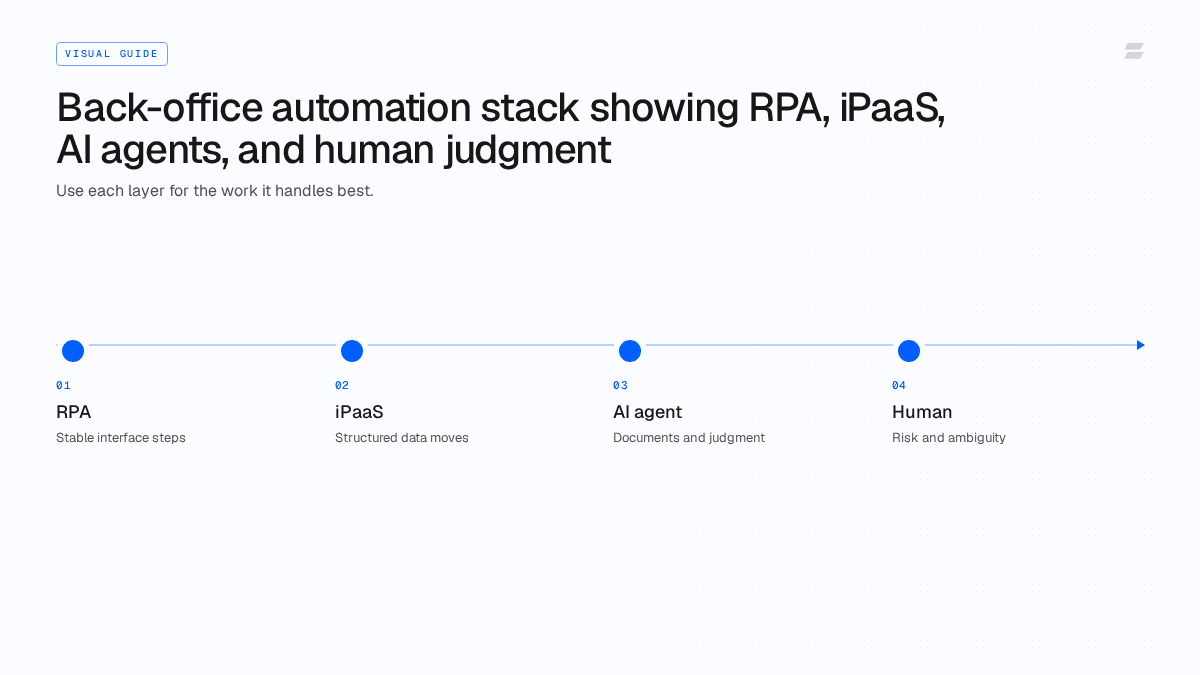
OCR can extract a document. RPA can move fields through a stable screen. A workflow can route approval. A copilot can draft an explanation. These tools can improve individual steps, but a person still has to understand the case, decide why a step failed, gather missing records, and move the work forward.
A finance agent coordinates those components around one outcome. It may call extraction, matching, workflow, and system actions, while retaining responsibility for the case and its evidence. That is the practical difference between agent-first architecture and the older pattern of bolting an AI feature onto an RPA or workflow tool: the agent owns the outcome end to end instead of being one more component a human has to supervise.
New work arrives through an approved source such as an inbox, queue, file, form, database change, system event, or schedule. The agent creates one case with an identifier, owner, service expectation, and idempotency rule so a retry does not duplicate the work.
The agent gathers the records needed to understand the item and follows a declared hierarchy when sources disagree. A contract, ERP record, approved policy, bank record, and email should not carry the same authority by default.
Arithmetic, required fields, duplicates, thresholds, date logic, balances, and other precise rules should run through deterministic checks. This keeps simple controls inspectable and limits where judgment is needed.
The Agent Operating Procedure, or AOP, records how the organization runs the job. It includes the outcome, sequence, sources, policies, tolerances, tools, approvals, recovery steps, evidence requirements, and known exceptions. In Zamp's model, the process owner drafts and edits the AOP directly, in plain language, without opening an engineering ticket. That is a deliberate design choice: the person who owns the policy should be the one who can change how the agent applies it.
The agent acts through the narrowest useful permission: read, propose, attach, comment, update, submit, post, or release. These permissions should be separated rather than granted as one broad role.
Cases outside authority, policy, or confidence go to a named reviewer. A useful handoff includes the source records, findings, rule, attempted actions, money or control at risk, and one specific decision.
After a write, the agent reads the target record back and compares the expected state with the actual state. The case log retains inputs, sources, checks, decisions, approvals, actions, results, retries, and corrections. A reviewer can reconstruct the full decision from that log alone, without relying on any summary the agent wrote about itself.
A correction should not disappear into chat history. The process owner reviews it, decides whether it changes policy or handling, and updates the AOP so similar cases use the approved lesson. Zamp keeps this accumulated context in what we call a Company Brain: a persistent, reviewable record of how each job is actually run. The system gets more accurate the longer it operates, instead of the same correction getting made over and over every quarter.
Finance jobs share records but keep separate accountability. Procurement creates the order and approval context. AP validates the invoice and prepares it for payment. Reconciliation compares the posted and external records. Close tests completeness and books supported adjustments.
A handoff standard should define the case identifier, required records, completion status, open exception, owner, due date, approvals, and evidence link. That standard prevents each downstream role from rebuilding the case.
This is the bar that separates a production-grade finance agent from a demo, and it's the bar regulated environments actually enforce:
The AI employees complete guide explains the category. The finance teams guide focuses on evaluating the commercial solution.
A process can look connected and still fail when the agent cannot attach evidence, select an entity, submit an approval, update a status, or confirm the write. Review every required action, not only the system logo.
Zamp can work through APIs, custom MCP servers, files, databases, email, and browser-based applications, and can be deployed as multi-tenant SaaS, in a customer's own cloud (BYOC), or fully on-prem for teams whose data residency or regulatory posture requires it. The deployment model changes where the agent runs. It does not change the work: authentication, identity, reads, writes, attachments, rate limits, retries, and final-state behavior all still need to be tested for the exact customer configuration.
Start narrow and expand on internal pull rather than rolling out every finance job at once. In practice:
Use internal data for the baseline and show every assumption. A vendor estimate cannot establish the organization's cost, risk, or payback. The case studies worth trusting are the ones that publish this kind of internal, verifiable baseline instead of a headline percentage with no denominator attached.
A process with no owner, disputed policy, inaccessible source records, unbounded authority, or an output that cannot be verified is a poor first deployment. Fix the process or choose a narrower job before adding an agent.
Ask a vendor to run a representative case, including an exception, through the real systems. Review the inputs, decisions, approvals, system writes, verification, recovery behavior, and evidence before judging the interface.